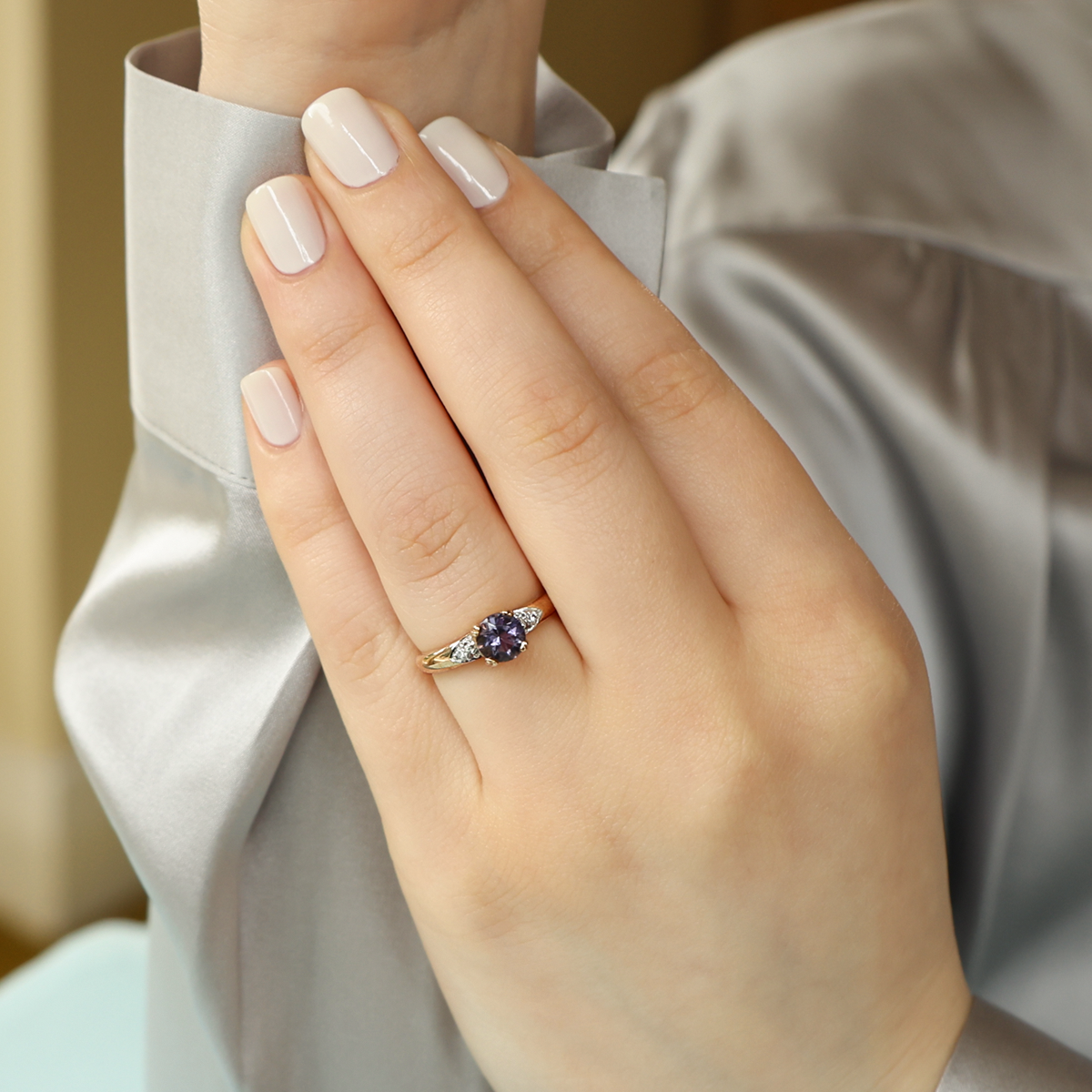
This estate ring comprises of single round mixed cut iolite, securely set central within a four prong setting. A trio of round shaped white topazes, flank the centre iolite and are set in a triangular shaped bead and bright setting. The setting has been rhodium coated white to enhance the design. The ring is mounted within hallmarked 9ct yellow gold.
Material: 9ct Yellow Gold
Brand: Lewins Vintage
Style: Solitaire
Primary Stones: Iolite, 1 Round Mixed Cut, apx. total carat weight: 0.74cts
Accent Stones: White Topaz, 6 Round Mixed Cuts
Anniversary: Iolite - 21st
Ring Size: M.5
Resizeable: Yes
Weight: 2.27 grams
Condition: Good (wear consistent with age and use)
Period: Estate, Contemporary
Hallmark: The standard mark, "375". The assay office mark of Birmingham. The date letter mark "j", indicating 2008. The maker’s or sponsor’s mark, "DK".
Jewellery Odyssey:
Solitaire, derived from the latin words 'solus' and later 'solitarius', meaning to be: alone, sole or lonely. In jewellery terminology, the word solitaire refers to settings of ring, earrings or pendants that are set with a single gemstone. The setting is generally associated with diamond engagement rings and can be dated back to the Ancient Roman times. When single uncut diamonds were set in gold bands. Variations of the design, are sometimes seen with accent diamonds set on the shoulders of the ring.
Gem Lore:
Iolite - possesses strong pleochroism, a phenomenon that when seen from different angles, displays (trichroism) three colours: Violet, Blue & Pale Yellow. This relies on Iolite being doubly refractive, whereby a ray of light passing through the gem, would split into two. When viewed through polarising filters, these rays of light absorb different parts of the visible light spectrum (white light), resulting in two different colours being seen at a time.
When Iolite is fashioned in thin slices, the gemstone acts as a polarising filter, removing fine mist and haze, making things seem visibly clearer to the eye. It was thought that the ancient Vikings used these slices of iolite, to locate the sun on a cloudy day. In ancient literature, the Vikings referenced the gem as ‘Sunstone’. Alternatively, Viking explorers were thought to take advantage of Iolite’s pleochroism, to help navigate them at sea. Vikings would observe the different colours of the gemstone, as the sunlight passes through, guiding them to the direction of the sun. It is often referred to as the ‘Vikings Compass’ or ‘Twilight Compass’.
Topaz - has been linked with the ancient Greek word ‘Topazions’, which was an island in the Red Sea. The island is currently referred to as ‘Zabargad’ in Egypt (and can further be translated to St John’s Island in english). Coincidentally, the island mined many yellow and green gemstones and incorrectly referred to them as Topaz. Alternatively, the name is thought to derive from the Sanskrit word ‘tapaz’, which translates to ‘fire’. The Egyptians believed that their Sun God Ra, provided the stones golden colour and protected the wearer from harm. Topaz naturally comes in white, yellow, brown and with the aid of treatment, pink and blue. Blue topaz possess a range of shades from: pale 'Sky Blue', to moderate 'Swiss Blue' and vividly saturated 'London Blue’. The most prized variety exhibits an orange body colour with pinkish red overtones and is known as imperial topaz.
Ring Resizing Service - How To Request Your Size:
If the current ring size listed under the details section, does not match your requirements. Please complete the enquiry form: including the reference code of the ring, which is located above the price, along with the ring size you need.
We will assess the feasibility of your request and provide you with a quotation for the bespoke alteration. If you decide to proceed, we will email you a link to review and process your customised order.
*Please Note: our resizing service typically requires a timeframe of 10 to 14 working days to complete. Rings that have been resized, cannot be returned for an exchange or refund.
Can Any Ring Be Resized?
No, depending on the design and setting, some rings cannot be resized. Whilst other rings can be safely resized up or down, by one to four sizes.
Are There Limitations To Resizing Rings?
Yes, it is important to appreciate that rings are made to fit their current size. When a request is made to significantly reduce the current size, it can result in the band developing an oval shape. Equally, increasing the size beyond a certain point, can alter the curvature of the band. Such modifications can potentially compromise the stability of settings, that hold gemstones securely in place.
As a result, there are limitations on how much a ring can be resized without compromising its structural integrity. If a requested size change impedes the durability of the ring, alternative solutions such as incorporating a half shank or soldered beads, if appropriate can be suggested.
Remember there is only about a 1mm difference between each whole ring size. For more information on what to consider when finding your size, read our blog: "The Factors Affecting Ring Size”.
Jewellery Care Precautions:
Avoid direct contact with: perfume, lotions, skincare, hairspray / other chemicals. Remove, your jewellery: when showering, swimming (as both chlorine and saltwater will react with metals), washing your hands / using hand sanitisers, before going to bed or when participating in physical activities (going to the gym, exercising, gardening, housework etc….).
Beware, metals may tarnish over time due to oxygen contact and natural body oils. Prevent items from being exposed to moisture and direct sunlight, for long periods. Store jewellery in a dry place away from humidity, in a pouch/jewellery box and keep each piece separated from each other. Care, for your jewellery by cleaning with a soft dry cloth.
Yellow Gold:
Gold as an element, in its purest form will not tarnish, but gold used in jewellery has been alloyed with other metals, to increase durability. These metals have properties that when in contact with oxygen, chemicals, oils or other substances - will result in a surface tarnish or damage and corrosion. Even the pH level of you skin and the natural oils it produces, can tarnish your gold jewellery.
To prevent your gold jewellery from tarnishing or even disintegrating, avoid exposure to household chemicals, bleaches, toothpaste, baking soda and other cleaning abrasives. Wearing jewellery in places where perfumes, hairsprays, body lotions have been applied on your body, will increase tarnishing. Wear your jewellery after the products have been applied. To clean your gold jewellery, use a mild soap with warm water and dry with a soft cloth. For professional cleaning, our workshop can polish your jewellery back to life.
Iolite:
Hardness: 7-7.5 | Toughness: Poor, Brittle | Stability: Fair to Good
Extreme Caution, Avoid: Sudden Impact (knocks), Extreme Temperature Change (thermal shock), Chemicals (acids, detergents), Jewellery Cleaners (ultrasonic, steam cleaners).
Gemmological Observation: Clean with mild soapy water and dry with a soft cloth. Iolite is a very brittle stone, take extra care when wearing this gemstone to avoid knocks, scratches or abrasions. Do not expose this gemstone to extreme temperature changes, as they will be prone to damage.
Topaz:
Hardness: 8 | Toughness: Fair | Stability: Good
Extreme Caution, Avoid: Sudden Impact (pressure, knocks), Extreme Temperature Change (thermal shock), Jewellery Cleaners (ultrasonic, steam cleaners).
Mild Caution, Avoid: Light.
Gemmological Observation: Avoid leaving for long periods in strong light, as in some cases the colour may fade. Avoid any rough handling that can cause abrasions. Topaz has a low toughness, as it possess moderately easy cleavage, which means that the stone can fracture if it experiences a sharp knock.